SaaPAICategory Design
Software as a Partner: The New SaaS in the Age of AI
Clarence Wooten · July 16, 2026 · 10 min read

For two decades, software sold us better tools. The next two will sell us teammates. Why the age of Software as a Service is quietly ending — and what comes after it.
Every piece of software you have ever paid for has one thing in common: it waited for you.
Your CRM waited for you to log the call. Your analytics dashboard waited for you to ask the question. Your project tracker waited for you to move the card. The most advanced SaaS products on earth are, at bottom, exquisitely designed cockpits — and every one of them assumes there is a pilot. You.
That assumption was invisible for twenty years, because there was no alternative. Software could store, sort, calculate, and display. It could not decide, plan, or act. So we built an entire industry on a single division of labor: the software holds the data, the human does the work. We called it Software as a Service, and it became one of the great business models in history.
It is also about to be replaced.
What SaaS actually did
To see what's changing, you have to be honest about what SaaS actually accomplished — and what it didn't.
SaaS unbundled software from ownership. Instead of buying a disk and a license, you rented capability by the month. That single shift democratized access to tools that used to require an IT department and a capital budget. A two-person startup could suddenly run on the same infrastructure as a Fortune 500. That was real, and it was revolutionary.
But look closely at what SaaS optimized. It made software cheaper to access, faster to deploy, and easier to buy. It did almost nothing to make the underlying work easier to do. If anything, it made it harder. The average company now runs more than a hundred SaaS applications. We didn't eliminate the operator's burden — we shattered it into a hundred dashboards, each demanding to be logged into, configured, filled in, and maintained.
SaaS gave us leverage on access and distribution. It gave us almost none on execution. The work — the judgment calls, the follow-ups, the actual doing — stayed exactly where it had always been: on a human being, toggling between tabs at 11 p.m.
SaaS handed you a better cockpit. It never gave you a pilot.
The thing that changed
Then software learned to reason.
This is the part the discourse keeps underplaying. The significance of large language models is not that they can write a poem or summarize a PDF. It's that, for the first time, software can take an ambiguous goal, break it into steps, choose among tools, act, observe the result, and adjust. Those are not the properties of a tool. Those are the properties of a worker.
When software can do that, the atomic unit of the product changes. For fifty years, the unit of software was the feature — a capability you invoked. The unit of AI-native software is the outcome — a result it delivers. The dashboard no longer waits for you to fill it in. It fills itself in, notices what's off, and brings you the one decision that actually needs a human.
The cockpit grew a pilot. And once that happens, the entire relationship between the person and the software inverts.
Software as a Partner
That inverted relationship needs a name, because it is not a better version of SaaS. It is a different category. Call it Software as a Partner — SaaP.
A partner is defined by three things a tool never had:
Context. A tool starts fresh every time you open it. A partner remembers. It knows your business, your customers, your last decision and why you made it. Its usefulness compounds, because it accumulates the one asset tools throw away every session: history.
Agency. A tool responds. A partner acts. It doesn't sit idle until summoned; it works between your visits and shows up with progress instead of an empty form. The default state of a tool is waiting. The default state of a partner is working.
Accountability. A tool is responsible for a feature working. A partner is responsible for an outcome landing. You don't evaluate a good partner on whether the button clicked — you evaluate it on whether the job got done.
Context, agency, accountability. No amount of UI polish turns a tool into a partner, because the difference isn't in the interface. It's in who owns the work.

The new operating model: Approve, Delegate, Direct
Here is the part founders and operators need to internalize, because it changes what your own day looks like.
In the SaaS era, you operated software. In the SaaP era, you manage it — and management is a fundamentally different skill than operation.
The old verb was Do. You opened the tool and did the work. The new verbs are three. I've come to think of them as the operating system of the AI-native company — and the order matters, because it runs from the work you barely touch to the work you touch most:
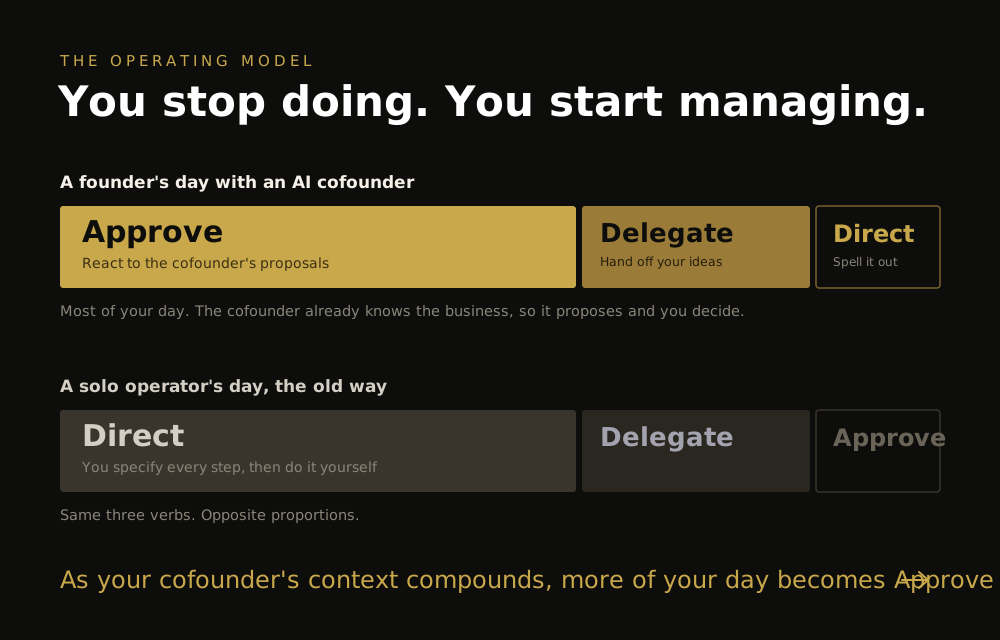
Approve — this is the default. A good partner isn't idling until you assign it something; it already knows where the business stands and what it needs next, so it makes the call and brings you the decision. Most of your day becomes a stream of proposals to approve, redirect, or veto. It supplies everything leading up to the judgment; you supply the judgment.
Delegate — sometimes the idea starts with you. Here the partner is a thought partner first: you think out loud, it sharpens the idea, and then it hands the refined work down to the specialists who execute it. You brought the spark; it did the shaping and the staffing.
Direct — occasionally you know exactly what you want, down to the specifics. So you say it plainly and the team executes to the letter. This is the highest-effort mode — and, done right, the rarest.
Notice what that ordering implies. Traditional management is upside down from this: a founder spends most of their time directing and the least approving. SaaP inverts it. Because the partner's context compounds — every decision, every outcome, every correction sharpens the next proposal — the need to spell things out decays over time. It proposes well from the first day and better every week after. The more your cofounder knows the business, the more of your day collapses into Approve, and the less you ever have to Direct. Your leverage stops being how much you can personally execute. It becomes the quality of your judgment on what the machine brings you.
This also answers the anxiety that always surfaces here. "If software does the work, what's left for the human?" The scarce resource simply moves up a level — from labor to judgment, from doing to deciding. Approve is not a formality; it's the whole job. The partner supplies tireless execution and a memory of the business that only deepens. You supply the taste, the risk tolerance, and the accountability a company ultimately requires from a person.
Why this breaks the business model
Categories don't fully arrive until the economics change, and here they change completely — though not in the way most people assume.
The lazy prediction is that subscriptions die and everything goes pay-per-outcome. That's not it. SaaP can be — and often is — still a subscription. What changes isn't the mechanism of pricing. It's the yardstick.
SaaS was priced on access — per seat, per month — and you judged that price against other software. Was it worth $30 a head next to the twenty other tools in the stack? The reference class was the software budget.
SaaP is measured against something else entirely: the labor it replaces. The right way to read a SaaP subscription is as human cost saved per action it executes — every task the partner completes carries a shadow price, which is what that task would have cost in human time. Stack those up and the monthly fee stops competing with your other apps and starts competing with a salary line. The number on the invoice may look like SaaS. The thing it's measured against is payroll.
The mechanism, in the end, doesn't much matter — subscription, usage, or pure outcome-based, the reference class is the same: human leverage, not software cost. That's the shift that actually defines the category.
It also flips the direction of value over time. In SaaS, cost climbs as you add seats — you pay more to get more. In SaaP, the partner executes more as its context compounds and you Direct less, so the labor it saves grows while the subscription holds flat. The ROI of the relationship improves the longer it runs. Seat-based software gets more expensive as you scale. A partner gets more valuable.

That is the real reason this is a bigger wave than SaaS, not a smaller one. The last era sold tools and competed for the IT line. This era sells work and competes for the payroll line. The addressable market of "software" was always a rounding error next to the addressable market of "labor." SaaP is the first category that gets to aim at the larger number.
"Isn't this just AI agents?"
The most common objection is that SaaP is a rebrand of "AI agents." It isn't, and the distinction matters.
Agents are a mechanism — the technical means by which software plans and acts. SaaP is a relationship — what that capability means for the person on the other side. Agent describes what the software is doing. Partner describes what it is to you. We spent the SaaS era obsessed with mechanisms — the stack, the API, the integration — and it made us forget that customers never bought mechanisms. They bought outcomes. The companies that win the next decade will sell the relationship, not the runtime.
And trust? Trust is exactly why the operating model has three verbs and not two. A partner you can't correct is a liability, which is why Approve is load-bearing. The point of SaaP is not autonomous software that removes the human. It's accountable software that elevates them — from operator to principal.
We bet the company on this
I don't write this as a neutral observer. I've spent the last few years building on precisely this thesis.
At CoFounder.AI, we built what the name says: an AI cofounder for the people starting and running companies. Not a smarter tool, not a copilot bolted onto a dashboard — a partner that is, in our words, deeply technical so you don't have to be. The founder approves, delegates, and directs — mostly approves. The cofounder does the work — the building, the analysis, the follow-through that used to live in a stack of a hundred SaaS tabs.
I don't offer us as proof that SaaP is inevitable. I offer us as evidence that it's already buildable, today, by a team willing to treat software as a teammate instead of a tool. The category is not a forecast. It's under construction.
The question is changing
For twenty years, the defining question of business software was: What tools do you use? Your stack was your identity. You were the sum of your logins.
The next twenty years will ask a different question: Who's on your team? — and some of the most important names on that list won't be people.
SaaS sold us better tools and left us to do the work. SaaP does the work and leaves us to do what only humans can: decide what matters, and own the result.
The tools waited for us long enough. The partners have arrived.
Clarence Wooten is the founder and CEO of CoFounder.AI.
Your dream cofounder. Zero equity.
My Dashboard